
How to Search Cases by Name
For searching by name, the statewide tool is Utah Courts Xchange, which covers Utah County District Court and Justice Court cases alike. Xchange matches names exactly as first filed. That makes spelling, suffixes, and punctuation worth checking twice. A business goes in the Last Name or Company field, not spread across both. The official help allows an asterisk after the opening letters of a name, though a query that broad can pull a huge list and still count as a paid search.
- Choose the Guest path, sign in to an account, or create an account at Xchange.
- Select District Court, Justice Court, or both. Pick both when the court level is not known.
- Enter the last name or company name, then add the first name or a first-name fragment.
- Narrow the query to Utah County, a court location, a case type, or a filing-date range.
- Open the matching row, then use the case-history link for the chronological event record.
The official Xchange help page lays out each field and warns that results get capped. Begin narrow enough to dodge false matches. Widen one field at a time only if the true case fails to surface.
| Search field | Input | Required | Utah County use |
|---|---|---|---|
| Jurisdiction | District, Justice, or both | Yes | Controls which trial-court level is searched |
| Last Name / Company | Text and wildcard | For name search | Uses the name as first entered in the case |
| First Name | Text and wildcard | No | Reduces common-name results |
| County or court | Selection | No | Narrows to Utah County or a named court location |
| Case type | Utah code | No | Separates civil, criminal, traffic, and other matters |
| Date range | Dates | No | Limits filing, disposition, or judgment dates |
Utah County Xchange Fields
The Xchange screen takes more than a name. It also accepts jurisdiction and search type. Case number, court scope, a birth-date filter, citation number, and several date panels are on the screen too. Each control can shrink or reshape the result set. Filter by birth date only where the screen permits it. Never republish a private identifier copied from a result. Choose "all cases" when hunting an active matter. A judgments-only search can skip cases that carry no judgment yet. The Utah Courts search-field reference shows the controls that narrow a Utah County case lookup.
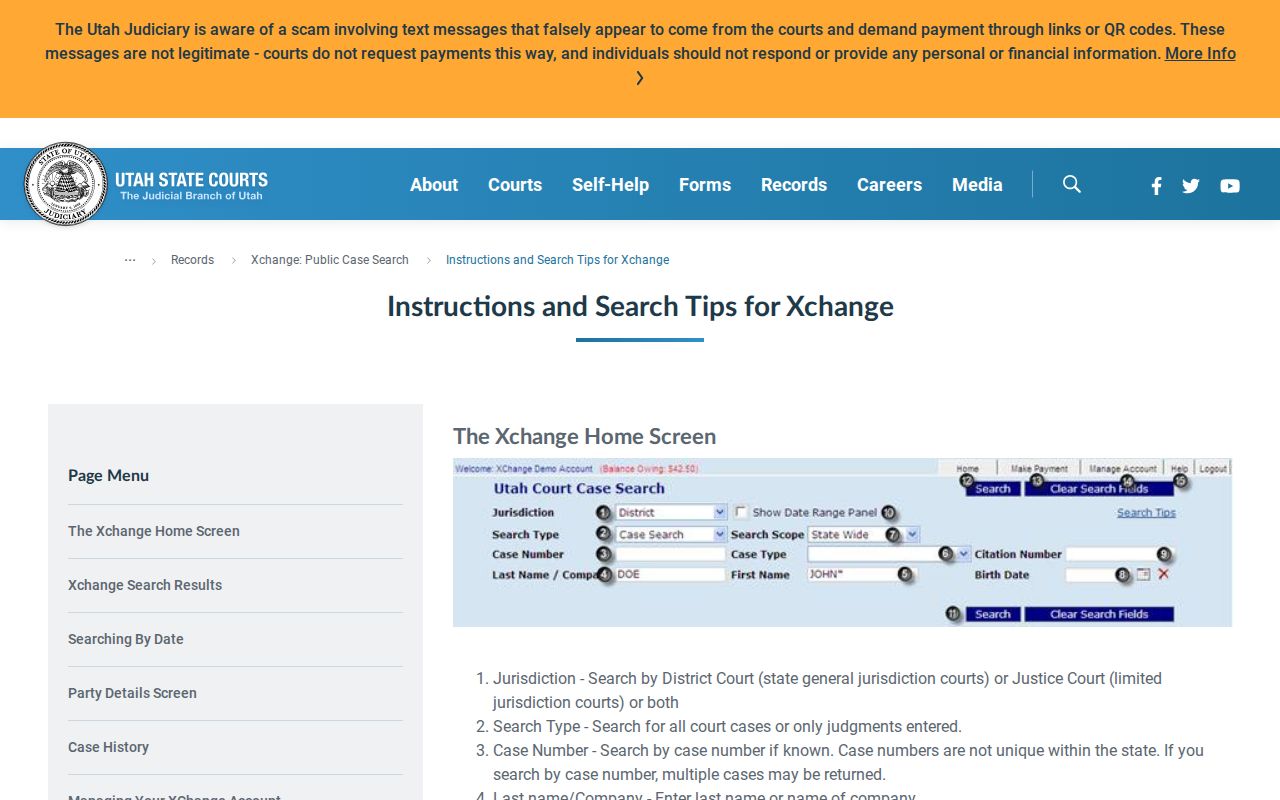
Used well, those filters keep a common-name search under the 500-result maximum. They also keep the docket results pinned to the right Utah County court.
How to Search by Case Number
A case number is a strong key. Use it when you hold both the number and the court. Utah Courts warns that numbers are not unique statewide. Pair the digits with Utah County and the court location. The visible format shifts by court and case class. So copy the number exactly from a filed notice, citation, order, or clerk receipt. A sound search pair reads case number + Utah County court. Case-type codes add a second check. Criminal filings carry codes such as FS, MD, MO, and IF. Traffic records run under TN, TC, PN, or PC. Civil and related matters use CN, DC, EV, SC, plus probate and domestic codes. A code names the filing class, not a ruling on the facts. The official Utah case-type code list shows how Xchange classifies each result.
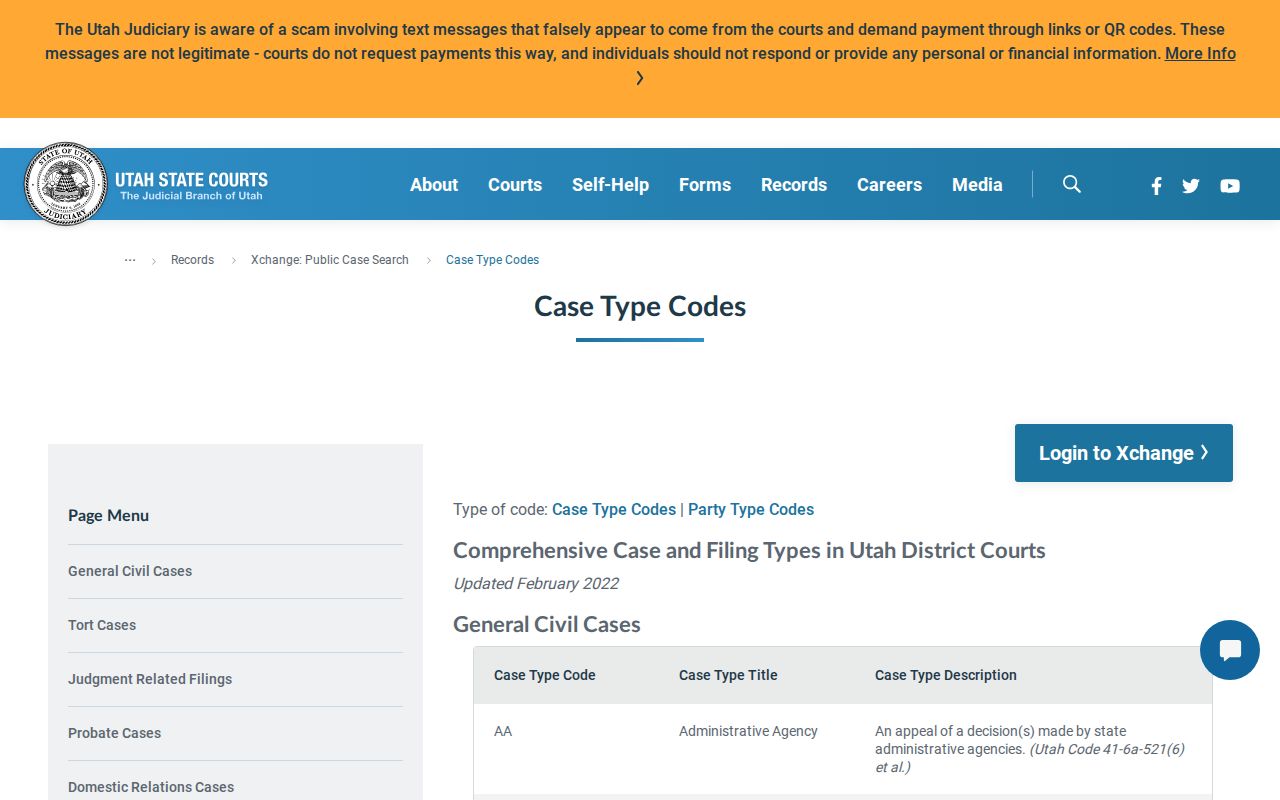
Matching code, location, and number together keeps a Utah County case from blending into a record elsewhere in the state. That cross-check takes seconds and saves a wrong-case conclusion.
Note: A citation number also needs its filing location because citation numbers are not unique across Utah.
Utah County Guest Access
Xchange gives you two ways in. Guest access costs a one-time $10 charge under the current subscription terms, and that credit goes straight toward searches, which bill at $0.35 each. A guest session lasts up to 24 hours, though unused credit vanishes when the browser closes or after 30 minutes of inactivity. Monthly accounts run $25 to set up plus $40 per month, include 500 searches, and then charge $0.35 each past that allotment. Public electronic documents, where available, cost $1 each.
To use it, you sign in at the live Xchange login page, which asks for a username, password, CAPTCHA, and account-recovery controls.
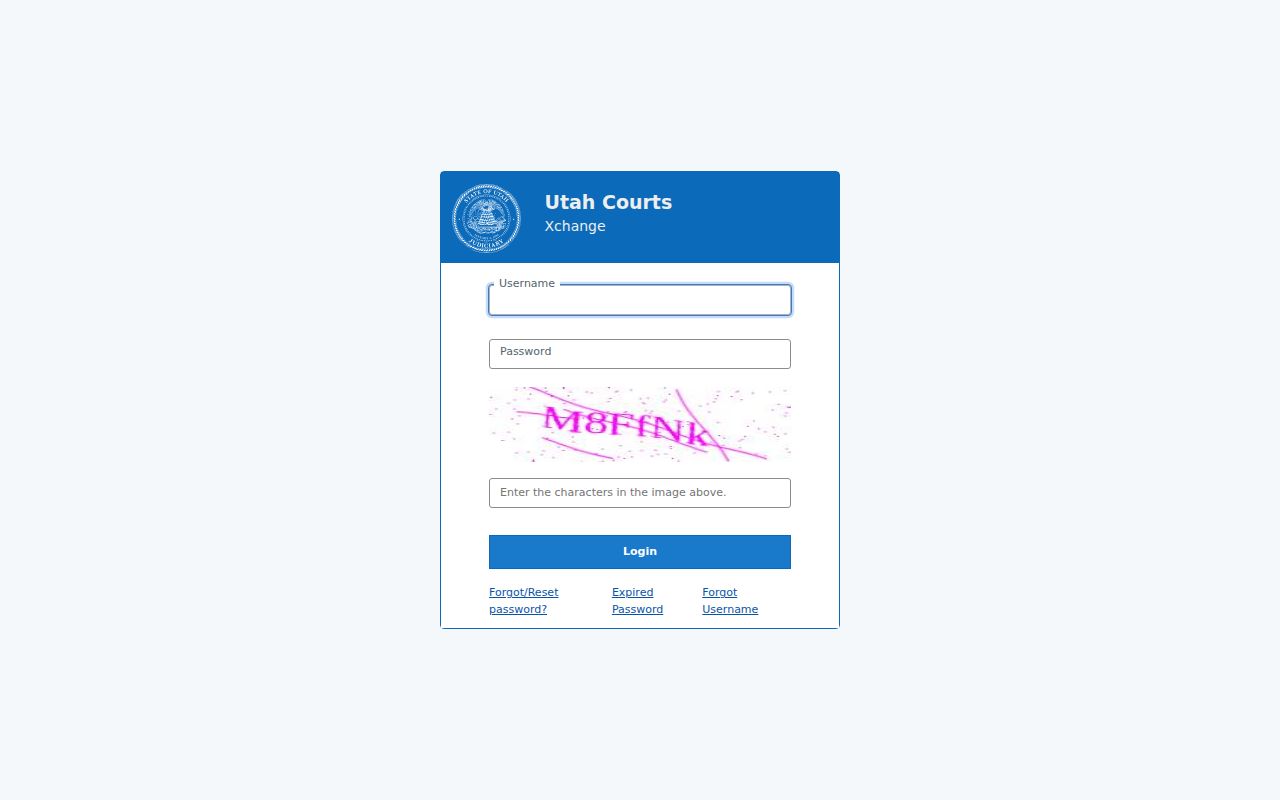
That account gate belongs to the statewide public system, not a private vendor. A free public terminal at most District Court locations remains the no-search-fee route for Utah County case information.
What a Case Search Shows
A Utah County result row can show the county, court location, case type, case number, filing date, party, party code, and links to case history or documents. The detail view may add the judge, attorneys of record, hearings, judgments, outcome, charges, pleas, and financial entries. Every field has limits, though. A scheduled hearing is not proof it happened. A filed charge is not a disposition.
| Case shell | Court, caption, number, type, filing date, and available status |
|---|---|
| Parties | Names and procedural party codes, subject to access rules |
| Events | Filed documents, hearings, orders, judgments, and other dated entries |
| Judge and counsel | Assigned judge and attorneys of record when shown |
| Document link | A separate purchase path when a public electronic image is available |
| Outcome | Disposition data that must be read by count and at case level |
Party codes describe a role, never fault. DEF means defendant, PET petitioner, RES respondent, CRE creditor, and DEB debtor. The official party-code reference gives the complete definitions.
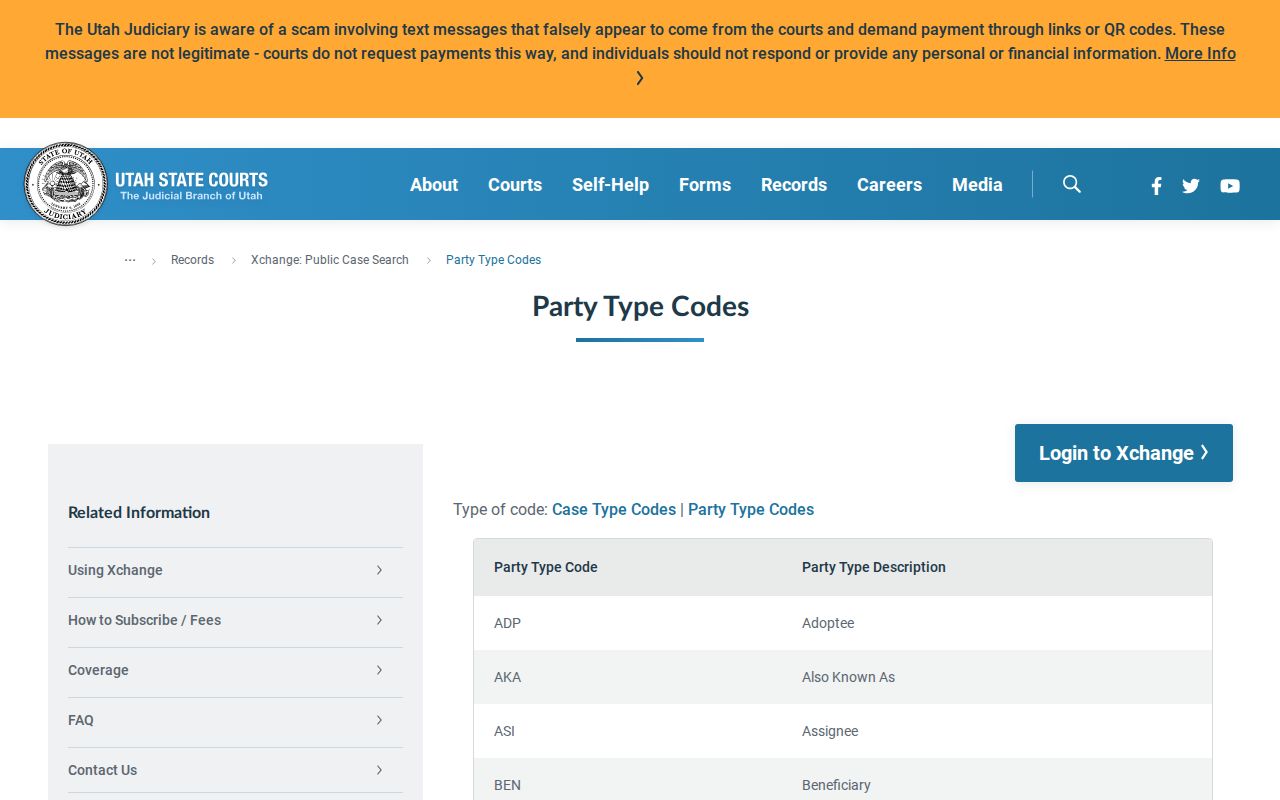
Read the code before concluding anything, so a procedural label never gets mistaken for a finding.
Utah County Search Limits
Xchange can cap a result list at 500. Every search may be billable. So a statewide sweep for a common surname makes a poor first move. Select Utah County first, then add the likely District or Justice Court level. Tighten further with a case type or date range. If spelling is in doubt, test a short stem with the wildcard after the court and county filters are set.
Search clue: The number link opens extended case history. It does not by itself open the filed PDF.
An event can show up while its image stays offline. The file may still be processing, sit outside electronic coverage, or be classified nonpublic. If the history lacks a public PDF you need, ask the clerk about inspection. Submitting the official record-request form beats repeating paid searches.
County vs Statewide Case Search
Utah County has no docket database of its own. Xchange is the statewide case search, and its filters narrow results to Utah County and its court locations. The local court pages do something else entirely. They cover fee payments, session links, and clerk contacts. MyCase sits apart as well: it serves people tied to a specific case, for free. It is not a substitute for a public Utah County court docket search.
| Route | Coverage | Best use |
|---|---|---|
| Utah Courts Xchange | Public District and Justice Court case information statewide | Name, number, citation, event history, and available documents |
| Utah County Justice Court hearings | County Justice Court sessions | Current session and Webex instructions |
| MyCase | A person's connected cases | Party functions and information not offered as a public search |
| Courthouse terminal | Public records at the court | Free case lookup and help locating the right file |
Need a hearing date instead of full case history? The Utah County court dates routes are built for that. Always confirm the setting against the latest posting.
Missing Utah County Cases
A docket search that returns nothing does not mean no case exists. Start with the basics. Check the name spelling, the court level, the location, the case type, and the date range. Staff enter case information into CORIS, and an entry may lag until that work is finished. Conversion dates for older records also vary by Utah County court location. A free courthouse terminal is worth a try. You can also call the clerk listed on your notice.
Access class is the other likely reason. Juvenile delinquency, child-welfare, and termination-of-parental-rights cases never appear in public Xchange results. Sealed and expunged court records are left out too. Even when a public case shell shows up, private or protected documents can still be withheld. Anyone entitled to nonpublic material must go through the court's proper access process.
Restricted Cases and Access Rules
Utah Code of Judicial Administration Rule 4-202.02 sorts court records into four classes. The classes are public, private, protected, and sealed. Only the public class carries a presumption of access. Rule 4-202.03 spells out who may see nonpublic records. A docket can mix the two. A public event line may sit beside a private pleading. The overlap is common in domestic, protective, medical, probate, and identifier-bearing filings.
Xchange may find the case but not the document you need. In that case, the Utah County court record request process can track down a public copy or a certified record. It cannot unlock sealed, private, protected, expunged, or juvenile material. No request changes a record's class.
Note: Verify any key date, outcome, or document with the clerk that maintains the originating Utah County case file.