
Searching the Spanish Fork Court Docket
Utah Courts Xchange is the paid source for public District and Justice Court case information. Start there. Choose District Court and Spanish Fork when the case sits at the local Fourth District site. A case number makes the search fast. Without one, narrow a name by county, court, case type, and filing dates. Case numbers are not unique statewide. A broad hit can point to a different court.
Free public terminals wait at most District Court locations. MyCase serves the parties on a case, not the public at large. The Spanish Fork clerk handles public inspection, papers that never entered Xchange, and certified copies. Juvenile matters do not surface as ordinary public Xchange results.
- Identify District, Juvenile, or another court from the notice.
- Select the court and Spanish Fork location in Xchange.
- Enter the number or a narrow name and date search.
- Match type, caption, filing date, and party role.
- Confirm settings and copies with the correct clerk.
Guest access is time limited and billable. Tight Spanish Fork filters keep the meter down. Listed terms run $0.35 per search and $1 for an available image, so confirm current prices before relying on them. Paying does not widen the public record class or replace a certified copy from the clerk.
Spanish Fork District Court Docket
Spanish Fork District Court sits at 775 W Center, Spanish Fork. The published phone is (801) 804-4800. It is a Fourth Judicial District location. The court takes state trial-court work there. The city legal page names the Fourth Judicial District Court Spanish Fork Department for service, while the state court directory and contact page control current routing and records access. The official Spanish Fork court contact page shows the state location.
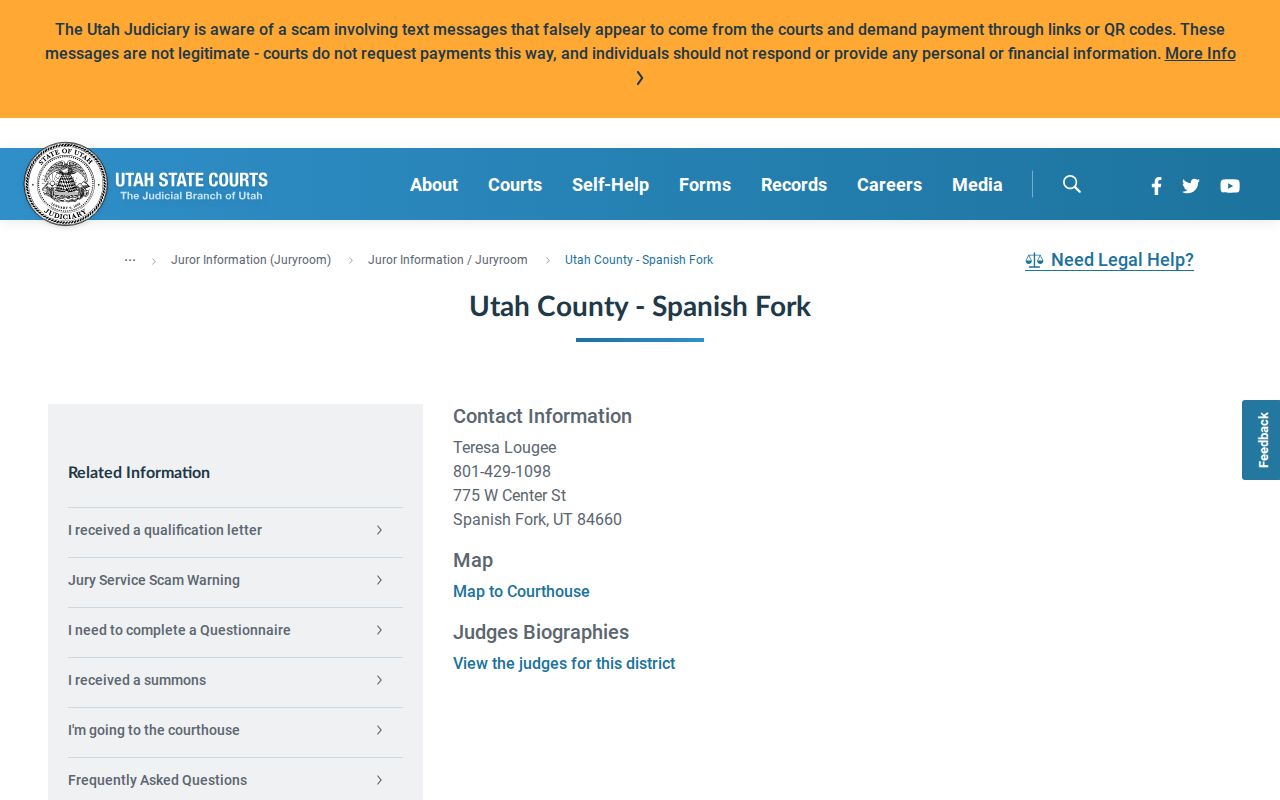
Verify contact details here first. An older case-history entry may carry stale routing, while the official listing reflects what the clerk uses now.
Spanish Fork Municipal Court
Spanish Fork posts no official city Justice Court listing. Heavy traffic does not create a court either. The documented local court is the state Fourth District Court location. The named filing court and the current directory control any citation.
That saves a wasted trip. A District Court matter should not land at a presumed city counter. Traffic can appear in District Court report categories. Other citations may name another authorized court. Read the citation and its Xchange location instead of guessing from the city name.
Spanish Fork Docket Filing Volume
The FY2023 Spanish Fork District report recorded 7,039 filings and 6,972 dispositions, a 99% aggregate rate. General civil logged 1,353 filings. Dispositions there reached 1,336. Criminal work contributed 1,280 filings and 1,293 dispositions, while traffic and parking led everything at 4,398 filings and 4,299 dispositions.
These numbers measure workload, not results. A rate above 100% can occur when the court closes older inventory during the current report year. This is not a conviction rate or a merits finding.
Spanish Fork Court Dates and Settings
Xchange history and the Utah calendar differ. History logs events already filed. The calendar shows scheduled activity across a two-week period, updated daily. When an old Spanish Fork event clashes with a newer notice, trust the current calendar and call (801) 804-4800. A reset or continuance moves a setting. It does not dismiss the case.
| Date | The latest scheduled hearing date. |
|---|---|
| Time | The posted start time for that setting. |
| Location | Spanish Fork court, courtroom, or remote indicator. |
| Judge | The judge named on the calendar or event. |
| Setting Type | Arraignment, pretrial, motion, trial, review, or another event. |
"Scheduled" differs from "held," "continued," "vacated," or "disposed." Read the event status next to its date, and ask the clerk when the attendance instructions leave you unsure.
Spanish Fork Traffic Docket Rows
The FY2023 report keeps traffic citations and traffic court cases in separate rows. Citations run 2,842 filed and 2,843 disposed. Traffic court cases sit at 1,331 filed and 1,266 disposed. Two Deferred Traffic Prosecution rows also appear. The labels do not swap, so read each row with its case type.
Xchange codes mark the same divide. TN tags a traffic citation, and TC tags a traffic court case. Parking codes sit apart too. A row names the kind of record, never whether a person paid, contested, or prevailed.
Spanish Fork Traffic Tickets
Let the court named on the Spanish Fork citation lead the way. The big District Court traffic total does not mean every local ticket follows one payment path. Not every ticket takes one path. Save the citation number and location. Check Xchange once processing finishes, then follow the named court's instructions for payment or appearance. A deadline holds even if the online case has not appeared yet.
Spanish Fork District Court filings go to that clerk. Ask there for the current setting and record. The city legal page is not a certified-record office. When another court is printed on the citation, its clerk, calendar, and payment rules control.
Spanish Fork Juvenile Docket Boundary
Spanish Fork Juvenile Court sits at the same 775 W Center address as the other court, but it keeps its own clerk and its own phone, (801) 804-4780. One building does not mean one docket. The juvenile docket stays separate. Delinquency, child-welfare, and dependency files are generally nonpublic, so a name search will not hand them over. That is by design. Spanish Fork also lists the Fourth District Juvenile Family Dependency Drug Court, and those program files can carry restricted juvenile or social records too. If you are entitled to a record, use the Juvenile Court's rule-based process. Do not expect District Court Xchange to reach it.
Where Spanish Fork Cases End Up
Spanish Fork cases split across three courts. Knowing which one matters for any docket search. Felonies, Class A matters, and civil cases outside small claims go to Fourth District Court. Domestic actions, probate, tort, property, and judgment matters go there too. Class B and C misdemeanors, infractions, ordinances, traffic, and small claims stay with the Justice Courts. That holds when the Justice Courts have jurisdiction. Juvenile Court handles youth and child-welfare cases on its own docket.
Docket flow: Named filing court › Utah County courts › Utah District Court, Fourth Judicial District
Appealing a Justice Court outcome usually sends the case to District Court. The venue there is a trial de novo. That means a brand-new trial, not a review of the earlier record. So the case now has two separate histories. Run a docket search at each level, under that court's own case number.
Spanish Fork Historical Docket Coverage
Spanish Fork's documented Xchange connection date is March 2, 1998. Treat that as history, not a promise. It does not mean every older paper file made it online. Nor does it mean each document since then carries an image. When public and available, current electronic District Court documents may sit apart from the case history itself.
An older Spanish Fork entry may have no PDF. Ask the clerk whether the paper file is public. Also ask whether you must inspect it or request it another way. Remember what the event list is: an index and a chronology. It does not prove that every source document was digitized. Nor does it prove each was classified as public or placed for sale.
Public Access to Spanish Fork Court Records
You have three routes into public Spanish Fork court records: Xchange, a free courthouse terminal, or a request filed with the clerk. The Judiciary form covers inspection, copies, fee-waiver grounds, nonpublic-access grounds, and qualifying expedited requests. Staff must locate the record, classify it, redact it, and arrange payment. An ordinary response takes up to ten business days.
Key Rules:
UCJA Rule 4-202.02 classifies records as public, private, protected, or sealed.
UCJA Rule 4-202.03 sets entitlement to nonpublic records.
UCJA Rule 4-202.06 governs response timing.
Just because a case shell is public does not mean every pleading inside it is. Juvenile files, sealed records, expunged material, private papers, and protected information all stay out of ordinary view in a Spanish Fork court docket.
Request a Spanish Fork Docket Record
If the paper you need is not in Xchange, fill out the Request for Court Record form. Name the Spanish Fork court, the case number, the document title, and the event date. Unsure which document you need? Ask to inspect the file instead.
Certified copies run $4 per document plus $0.50 per page. Other charges vary. Copies, delivery, staff time, audio, and transcripts are all priced separately. A transcript is its own product with its own process. For a transcript, identify the court, the case, the hearing, and the date. That request goes through a separate Judiciary path. The clerk is the office that supplies the certified court record. That keeps every Spanish Fork docket tied to the court that made it.
Describe the record clearly enough for staff to find it. Include the court location and the event date along with the case number. The number is not unique statewide. The form lets you explain a qualifying need for faster handling. It also covers a claimed right to nonpublic material. Neither box guarantees release. The court still applies its classification and access rules no matter what you write there.
For a routine public docket search, skip collecting identifiers you do not need. Party codes like petitioner, respondent, claimant, or defendant show a procedural role, not fault. A public Spanish Fork case shell can sit beside a private pleading. That happens especially in domestic or protected matters. Read only the public record. Let the originating clerk settle any access question.