
Getting Utah County Court Records
Start with case history through Utah Courts Xchange. One search there can surface the court, the case number, the events, and links to public documents. Electronic public District Court documents filed since July 1, 2010 may be sold through Xchange. That holds when they are available and classified for release. Note the difference, though. A case-history link and a document image are two separate things. The court also will not fax or email a record that Xchange already offers.
- Identify the court, location, case number, case type, filing date, and exact document.
- Check Xchange for the public case history and any available electronic document.
- Use a free public terminal at most District Court locations if paid online search is not suitable.
- Call or visit the clerk for the filing court to confirm custody, inspection, copy, and certification options.
- For a record not online, submit the Request for Court Record form to the correct Judiciary office by its accepted delivery method.
- Use mail only after confirming the recipient address, fee, and return-copy instructions with that court.
For a formal request, use the Judiciary request page, the statewide route. Delivery details differ from court to court across Utah County, so confirm the destination before you mail anything.
Utah County Request Form Fields
The official form wants a few essentials from you. You name the Judiciary recipient and address. Then you describe the record with reasonable specificity, and say whether you want inspection or copies. Beyond that, it asks about fee-waiver grounds and any basis for accessing nonpublic material. It also wants an explanation if you need an expedited response. Finish with your name, mailing address, phone, date, and signature.
| Court recipient | The District, Juvenile, county Justice, or municipal Justice Court that keeps the file |
|---|---|
| Case details | Case number, type, party or caption, filing date, and document title |
| Service sought | Inspect or view, plain copy, certified copy, audio, transcript, or another named record |
| Fee waiver | The listed basis plus explanation and supporting material |
| Expedited request | Media status or a stated public benefit from faster production |
| Requester details | Name, address, telephone, date, and signature |
Skip the catch-all. A request for “all records” can slow things down, so name the item and its date instead. Also know the limits: a records request is not a discovery subpoena, and it creates no right to private or sealed material.
Court Record Types
Different Utah County court records answer different questions. The case history gives you events and status clues, while a document image shows what a public filing actually says. Certification adds the clerk's official authentication. For the proceeding itself, audio preserves the court recording and a transcript turns it into a prepared written record. Much older files often sit in archive custody.
- Case-history or register output with chronological events and metadata
- Public filed documents such as complaints, motions, orders, judgments, or decrees
- Certified or exemplified copies produced by the court clerk
- Audio or video records of testimony, subject to access and fee rules
- Prepared transcripts and later certified or plain transcript copies
- Archive records transferred from the creating court to historical custody
Ask the receiving agency or court which form it requires. And be careful with labels: an ordinary Xchange PDF is not certified just because you paid for the event or the image.
Utah County Audio and Transcripts
Audio and transcripts travel separate request and price paths. For either one, identify the court, the case number, and the hearing date. Add the judge and the portion of the proceeding you need. Digital audio or video of testimony runs $15 per half-day. Transcripts cost $6 per page for initial preparation and certified copy. Later certified copies drop to $0.50 per page plus a $4.50 certificate. Later noncertified copies are $0.25 per page. The Utah Courts audio and transcript instructions spell out how to place each order. They also show which route fits which product.
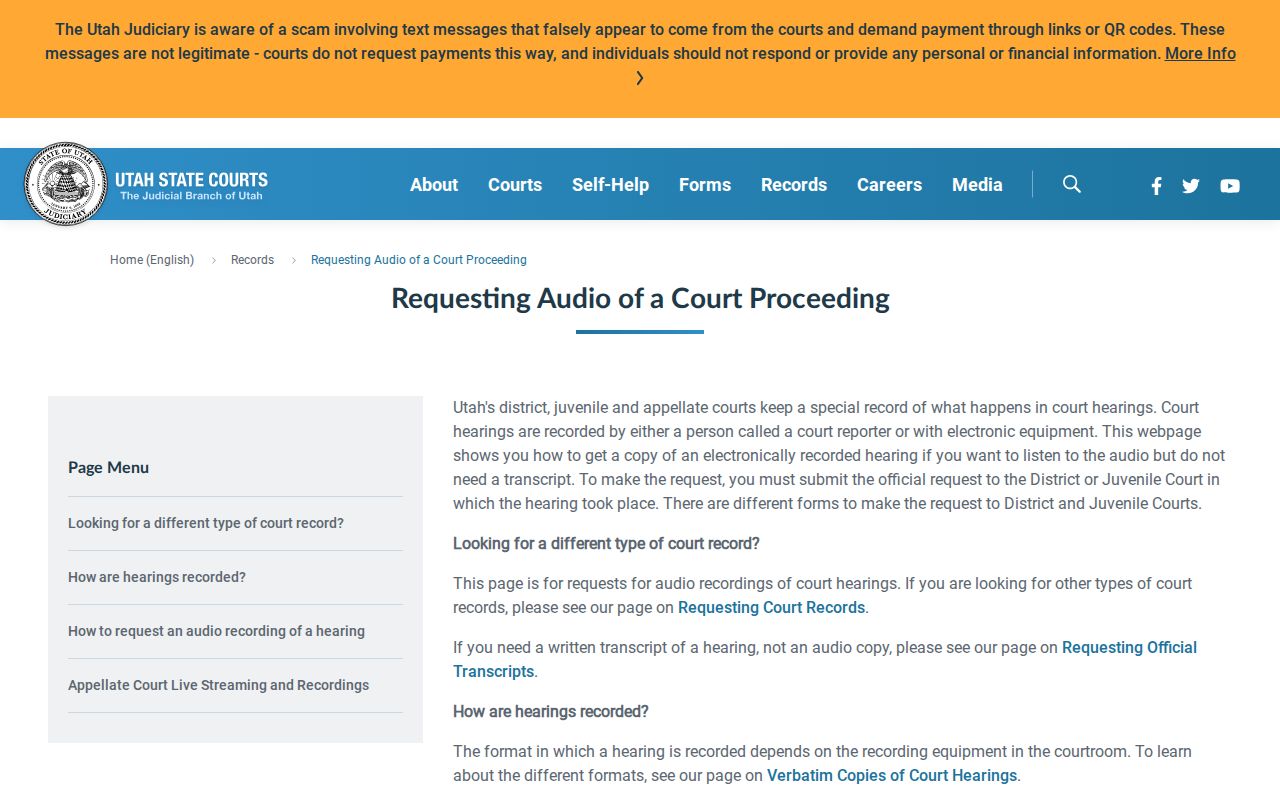
Pick the product that matches your purpose. Do you need to hear the proceeding, quote a written transcript, or file a certified copy somewhere else? That answer drives the request.
Inside a Utah County Court Record
A single case file can hold a lot. You might see the case shell, parties, counsel, pleadings, motions, orders, judgments, notices, hearing minutes, exhibits accepted into the court record, and financial entries. Public access varies item by item. A visible case caption does not make every attachment public, and a missing PDF does not mean nothing was filed.
| Case identity | Court, location, caption, case number, type, and filing date |
|---|---|
| Parties and counsel | Procedural roles and attorneys of record, subject to classification |
| Pleadings and motions | Requests and claims filed by parties, not proof that the court accepted the assertions |
| Orders and judgments | Court rulings and final or post-judgment action |
| Minutes and recordings | Records of proceedings that differ from the advance calendar entry |
| Certification | Clerk authentication attached to the specified copy |
Before ordering any document, locate the case first. A Utah County case lookup will give you the exact event title and date to write down.
Missing Utah County Record Images
Sometimes Xchange lists an event with no downloadable image. There are many reasons why. The item may still be processing, or it may predate electronic coverage. It may sit in a court or format outside that coverage, and it may be private, protected, sealed, or expunged. A blank link proves nothing about whether the document or event exists.
Take the event title and date to the clerk in a request. Ask whether the public record can be inspected, copied, or certified. Staff may then need to locate and classify it. They may redact material when the rules require that step. They may also estimate their time or arrange payment. One caution. The filer, not clerk staff, bears responsibility for removing protected personal identifiers before filing.
Key distinction: A case-history event, document image, certified copy, and transcript are four different court-record products.
Fees and Certified Copies
The current Utah Judiciary schedule sets different prices by product. Confirm the amount when you order, since fees can change and staff time or delivery can add cost.
| Utah court record service | Listed fee |
|---|---|
| Paper copy | $0.25 per sheet |
| Certified copy | $4 per document plus $0.50 per page |
| Exemplified copy | $6 per document plus $0.50 per page |
| Non-hearing electronic media | $15 per unit |
| Audio or video testimony | $15 per half-day |
| Fax or email | $5 through 10 pages, then $0.50 each additional page |
| Actual cost |
The first 15 minutes of staff time are free. After that, the court uses the least-cost qualified staff category. If you only need to read a public file, inspection or viewing can help. That can avoid copy charges altogether. Fee waivers are not automatic. They are limited to the grounds shown on the form. Before paying anything, check the official Utah Judiciary fee schedule.
Utah County Record Response Time
Under UCJA Rule 4-202.06, an ordinary Judiciary record request generally gets an answer within 10 business days. A qualifying expedited request moves that to five business days. Neither window guarantees instant documents. The court may seek clarification, classify the record, estimate cost, or arrange payment first.
Want the expedited box? It requires an explanation of media status or of how faster access benefits the public. Fee-waiver grounds include a government legal need, an impecunious subject of the record who supplies an affidavit, student academic research, or minimal government fees. Checking a box alone does not establish eligibility.
Note: Give the Utah County clerk one precise record description to reduce clarification and routing delays.
Older Utah County Court Records
Records more than 50 years old often move out of the courthouse. Utah State Courts notes that the Utah State Archives holds much of this older material. The holdings run from District Court files to municipal and Justice Court records. Anything newer stays where it was created. Unsure where a Utah County case file lives now? Ask the current court first. Its clerk can usually point you toward the right holder of the record.
The state's official court records and archives page lays out how to reach older files. It also notes what recording resources exist.
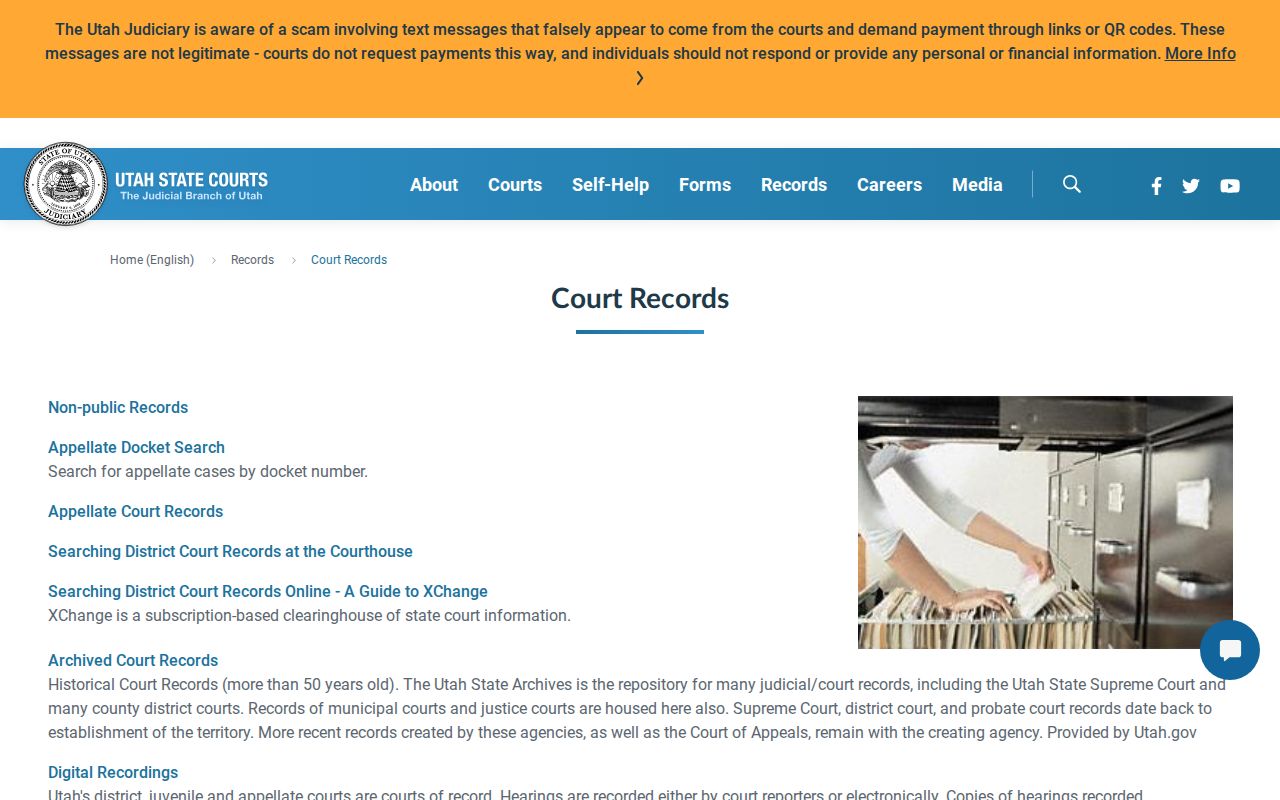
Digging through the Archives takes some homework. Old case numbers and court locations do not always match what you see in Xchange, so bring the court name, the place, a party, a date range, and the case type before you search.
Sealed Records and Public Access
Utah sorts court records into four classes: public, private, protected, and sealed. That split comes from UCJA Rule 4-202.02. Two companion rules fill in the rest. Rule 4-202.03 says who may see nonpublic material. Rule 4-202.08 covers fees and how records get served. GRAMA sets a baseline for state records generally. But a court docket request answers to the Judiciary's own rules, not that law.
Utah Courts publishes examples that show why the labels matter and how they stay distinct.
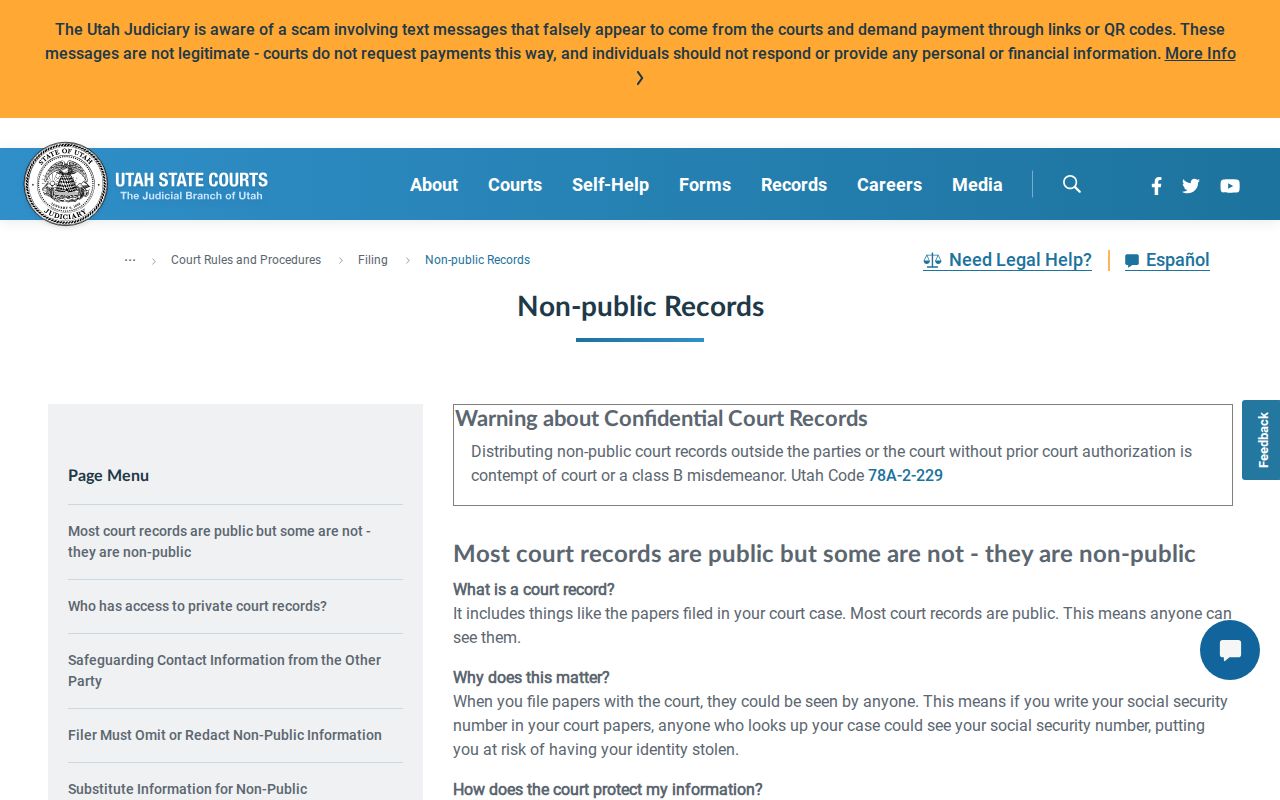
Keep the layers straight. A case shell can stay public even when a pleading inside it is private or protected. Juvenile, expunged, and sealed material sits under tighter limits still.
Access boundary: A request can secure a public record or test a claimed right to nonpublic material. It cannot reclassify a sealed file.
Utah County Court Record Clerks
The clerk you need depends on the court. Fourth District Court's clerical division holds the District Court files, and Juvenile Court runs its own clerical operation apart from that. Utah County Justice Court and each city's municipal Justice Court keep their own local dockets. One caution: the county Clerk/Recorder does not certify state-court case files.
Utah County Justice Court
151 S University Ave, Suite 3300
Provo, Utah
(801) 851-7200
jcutahco@utcourts.gov
Hours: 8:00 a.m. to 4:30 p.m.
Confirm before you go. The official Utah County court directory lists contacts for the District, Juvenile, county Justice, and municipal Justice Courts, so check it before visiting or mailing any request.