
Searching Utah County Criminal Dockets
Utah Courts Xchange is the paid public search route for Utah District Court and Justice Court case information. Start with the court level, not just a person's name. State felonies and Class A matters are routed to the Fourth District Court in Provo or Spanish Fork. Class B and C misdemeanors, many DUI matters, infractions, and local ordinance cases belong to the county or municipal Justice Court that filed the complaint or citation. A case number is a strong key inside the chosen court, but Xchange warns that it is not unique statewide.
Gather the case number, name spelling, likely court, and a useful date range. Xchange can search by case number or name and can narrow by jurisdiction, case type, and filing dates. The free alternative is a public terminal at most District Court sites. A connected party may use MyCase, while a member of the public should use Xchange, a terminal, or the filing clerk. These routes serve different users and should not be treated as substitutes.
- Open Xchange and select the District or Justice Court jurisdiction.
- Choose all cases, then enter the case number or narrow the name search.
- Match the court, case type, filing date, and party code before opening a result.
- Read each charge, plea, hearing, and disposition as a separate event.
- Confirm a current setting or request an official copy from the filing court.
Utah County Criminal Docket Codes
Xchange case codes give the first useful clue about a Utah County criminal docket. FS means State Felony. MD means Misdemeanor DUI, MO means Other Misdemeanor, and IF means Infraction. NA means no applicable severity. The code classifies the row. It does not state whether a charge was proved or how the case ended.
The official Utah case-type reference shows the code families used in the public search.
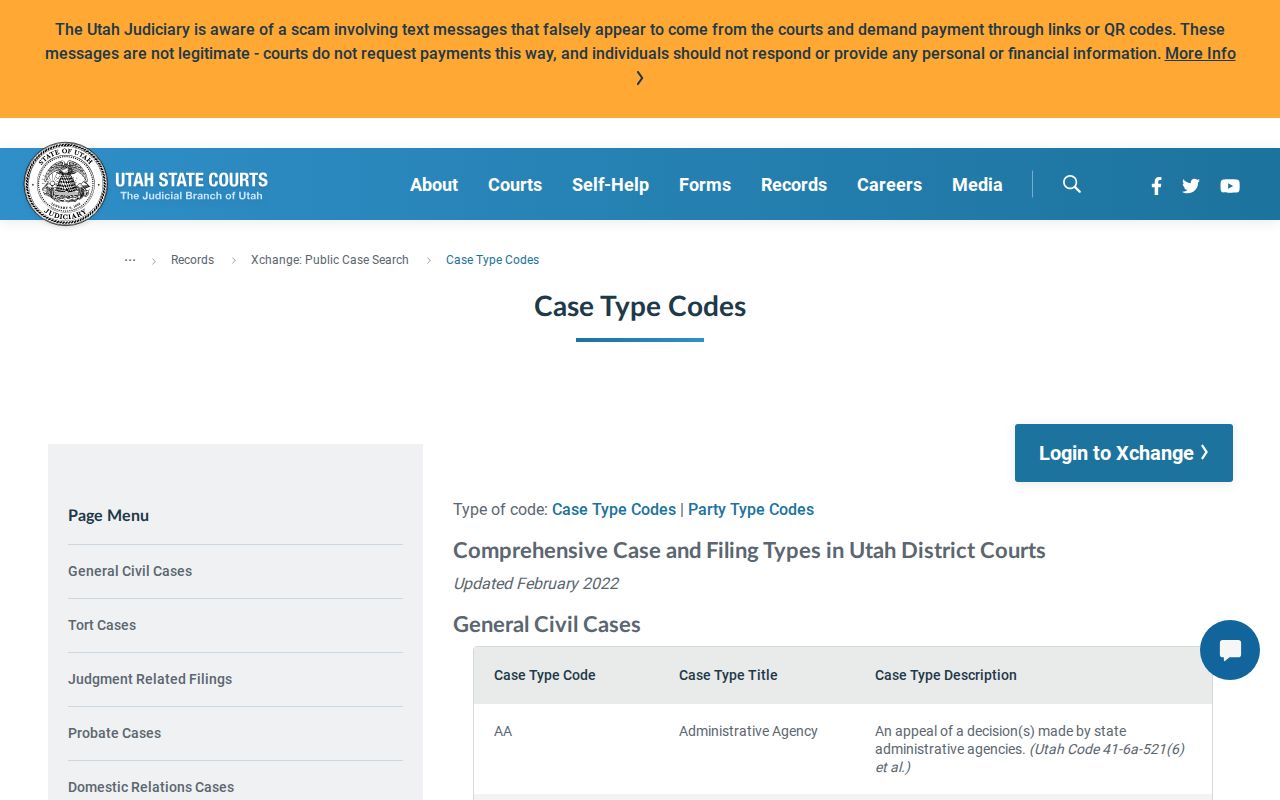
This reference helps a reader separate an FS felony row from an MO, MD, or IF row before checking the filing court and events.
Inside a Utah County Criminal Docket
The Xchange case history begins with the court, caption, case number, filing date, type, and status. It can then show charge identifiers, severity, special attributes, party roles, counsel, the judge, and a dated event list. Some records also show the citing or arresting agency, prosecutor, citation data, and a court-account summary. Those fields describe procedure. They do not prove an allegation, and sensitive identifiers should not be copied from a result.
| Case header | Court, caption, case number, filing date, case type, and case-history link. |
|---|---|
| Charge | Offense label, count, classification or severity, and special attributes. |
| Proceedings | Arraignment, pretrial, motion, hearing, trial, sentencing, review, reset, or closure. |
| Plea | The date and nature of a plea, separate from the final outcome. |
| Disposition | The date and nature of an outcome, which may differ by count. |
| Documents | Public complaint, plea, order, judgment, or sentencing image when separately available. |
An event title is not the document itself. Electronic District Court images filed in the covered period may be bought in Xchange, while a case-history view may remain visible without a downloadable image. The clerk can explain whether a public document must be inspected or requested through another official channel.
Charges Are Not Utah County Outcomes
A filed charge records an accusation. It is not a conviction. Likewise, a plea event is not always the disposition, and one disposed count does not prove that all counts ended the same way. Read each charge line and its later events together. A violation date may precede the filing date, and both can differ from a plea, hearing, judgment, or disposition date.
This distinction matters when Xchange offers a search for “judgment entered.” That search is narrower than “all cases” and may omit a pending case or one disposed without a judgment. Party codes and agency roles are also procedural labels. They do not establish credibility, fault, or the truth of what was alleged. For a complete reading, follow the dated sequence instead of taking one label out of context.
How a Utah County Criminal Case Moves
A Utah County criminal docket grows as court staff enter each filed paper and court event. The sequence may include the information or complaint, arraignment, pretrial settings, motions, a plea or trial, disposition, sentencing, review, payment, and closure. Not every case uses every stage. A continuance or reset changes the setting but does not dismiss the charge. “Scheduled” also differs from “held,” “vacated,” or “disposed.”
Docket flow: Filing › Arraignment › Pretrial › Plea or Trial › Disposition › Sentencing
Document due dates deserve care. A due date shows when a response or filing was expected, not that the filing arrived. A financial line can state amounts due, paid, or held in court accounts, but it is not a live clerk account statement. Check the newest entry and contact the clerk when current status controls what must happen next.
Utah County Criminal Filing Counts
Official FY2023 figures give local workload context. Provo District Court reported 4,383 criminal filings: 2,236 State Felony, 1,456 Other Misdemeanor, 449 Misdemeanor DUI, and 241 with no applicable severity. It reported 3,056 dispositions and a 70% disposition rate. Spanish Fork District Court reported 1,280 criminal filings and 1,293 dispositions, or 101%.
These rates are not conviction rates. A court can dispose of older cases during the same year that new cases are filed, so dispositions can exceed that year's filings. The totals describe work moving through two court locations. They say nothing about the result in one Utah County criminal docket. Use the aggregate report for context and the individual case history for dated events.
Courts That Hold Criminal Dockets
The Fourth District Court clerk or clerical division keeps Utah County files for state felonies and Class A-level matters at the Provo or Spanish Fork court as routed. Each county or municipal Justice Court clerk keeps that court's Class B and C misdemeanors, infractions, traffic matters, and ordinance cases. The Utah County Clerk/Recorder is not the state-court docket keeper.
That split explains why a broad name search may not be enough. First confirm whether the case was filed in District Court, Utah County Justice Court, or a municipal Justice Court such as Provo or Orem. Then match the location in Xchange. Juvenile delinquency follows the Juvenile Court path and is generally not ordinary public Xchange information. A missing juvenile result should not be treated as proof that no case exists.
Confirm Utah County Criminal Hearings
An old hearing in case history may reflect entry lag or a setting that was continued, reset, or vacated. Do not rely on the old line alone. Check the official calendar or the local session page, then ask the filing clerk when the date is urgent. An FTA or warrant-related entry also needs current confirmation because a later court action may not yet appear in the public case history.
The Utah County Justice Court hearing page provides session search and Webex instructions.
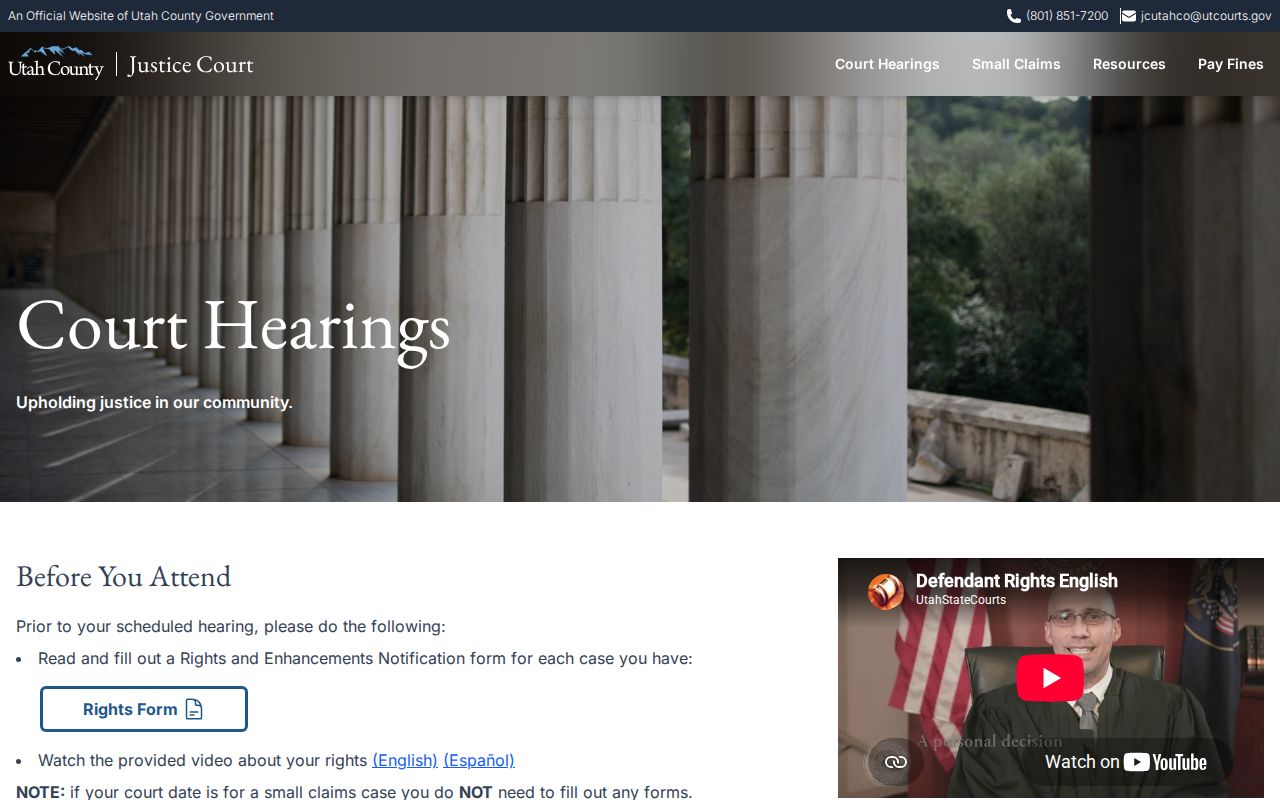
The local page also requires a rights and enhancement notification before a hearing, except for small claims, which makes it more useful than an old event line alone.
Utah County Criminal Docket Documents
Case history, a document image, and a transcript are three different records. The history is the dated index of acts in the case. A public complaint, plea, order, judgment, or sentencing paper may appear as a separate image for purchase. An image link can be absent because the paper is not electronic, is still being processed, falls outside image coverage, or is not public. Its absence does not erase the event line.
Audio and transcripts follow the Utah Judiciary transcript request route. A requester identifies the court, case, date, and hearing, then submits the right form and pays the applicable media or transcript fee. For a certified paper, contact the Fourth District Court clerk or the Justice Court clerk that holds the case. Each product answers a different need, so a Utah County criminal docket screen should not be presented as an official certified file.
Sealed Dockets and Public Access
Utah classifies court records as public, private, protected, or sealed. Xchange, public terminals, and ordinary public requests expose only material available under those rules. Sealed and expunged matters are not ordinary public search results. Juvenile cases are generally nonpublic. A public case shell may still have a document withheld because it contains protected information or belongs to a private record class.
Key Rules:
UCJA Rule 4-202.02 classifies records and sets public access subject to exceptions and court orders.
UCJA Rule 4-202.03 identifies who may obtain nonpublic records and on what basis.
UCJA Rule 4-202.06 generally gives the court ten business days for an ordinary record request.
For a public record that is not in Xchange, ask to inspect it at no copy fee or submit the Judiciary's Request for Court Record form with enough detail to locate the item. The filing court may need time to find, classify, and redact it. Audio and transcripts use a separate request path. An official certified copy must come from the clerk, not from a screen capture or a case-history printout.