
Searching Utah County Civil Dockets
Utah Courts Xchange is the paid public search for District and Justice Court case information. Select Utah County, the likely court location, and the civil case type before entering a case number or party name. The number works as a stable key within that court, but Xchange warns that a case number is not unique across the whole state. Name searches should therefore be checked against the court, filing date, case code, and party role.
The Fourth District Court clerk or clerical division keeps contracts, debt collection, tort, property, lien, probate, and domestic files. Justice Court clerks keep small-claims dockets. Public terminals at most District Court locations offer free lookup, while Xchange charges for online searches and available document images. A connected party may use MyCase. For a public inspection, non-Xchange paper, certified judgment, or classification question, use the filing clerk and the Request for Court Record process.
- Choose the District or Justice Court that is likely to hold the civil case.
- Search Xchange by case number or a narrowed party or company name.
- Match the case code, filing date, court, caption, and party roles.
- Read document titles, motions, settings, orders, and judgment events in date order.
- Ask the filing clerk to inspect or certify the controlling public record.
Utah County Civil Docket Codes
Read the Xchange code before drawing a conclusion about a Utah County civil docket. CN marks Contracts, DC Debt Collection, EV Eviction, LM Lien or Mortgage Foreclosure, and SC Small Claims. Other civil codes include MI Miscellaneous, PR Property Rights, TP Tax Protest, and WA Water Rights. Tort, domestic, probate, and judgment records use their own families.
The official Xchange case-code page displays these state classifications.
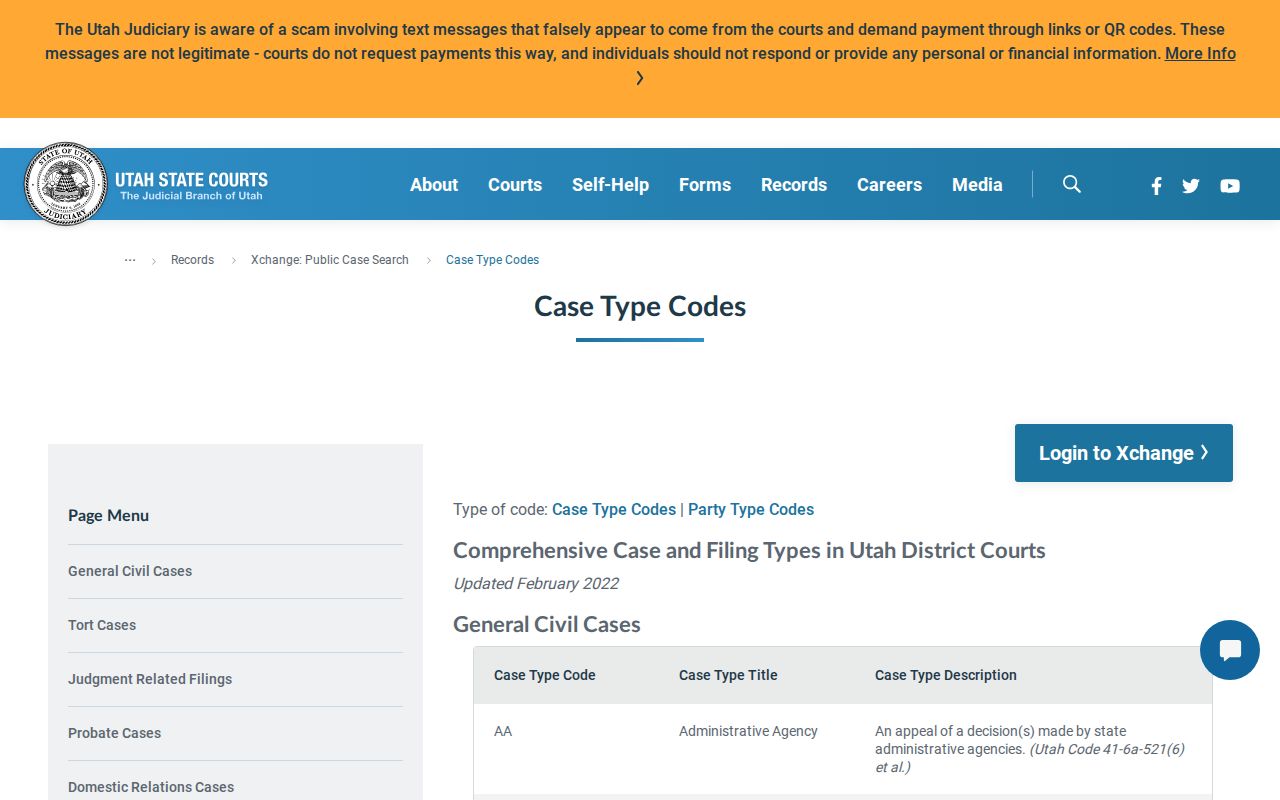
The code narrows the kind of docket, but it is not a ruling on the claim and must not be read as a finding of fault.
Inside a Utah County Civil Docket
The civil case shell identifies the court, caption or style, case number, filing date, and type. A full public case history can add party and attorney blocks, document titles, service or return entries, motions, notices, hearings, orders, settlements, judgments, and post-judgment events. Counterclaimants, intervenors, and third parties may have distinct role codes. Those labels describe where someone stands in the procedure, not whether the person's claims are true.
| Case shell | Court, caption, case number, filing date, case type, and status. |
|---|---|
| Parties | Claimant, petitioner, plaintiff, defendant, respondent, or other coded role. |
| Counsel | Attorneys of record linked to parties, subject to later changes. |
| Filings | Complaint or petition, response, motions, notices, service, and public document titles. |
| Events | Hearing held, continued, vacated, reset, disposed, or judgment entered. |
| Judgment lines | Amounts, liens, paid balances, and later administrative entries when shown. |
A financial line is not always the certified balance. When an amount controls a payment or enforcement step, obtain the certified judgment or a current clerk account statement. Likewise, a document title may appear without a PDF because the image is classified, still processing, outside electronic coverage, or not sold through Xchange.
Small Claims on Utah County Dockets
Small claims use Justice Court, not the general District Court civil path. The Utah County Justice Court page states a $20,000 ceiling. Venue ordinarily lies where the defendant resides or where the claim arose. If a municipality has its own Justice Court, that court is used; Utah County Justice Court handles the documented unincorporated-county route. Xchange has included statewide Justice Court small-claims public information since 2009.
The Utah County small-claims page provides the local limit, venue guidance, forms, court contact, and Online Dispute Resolution information.
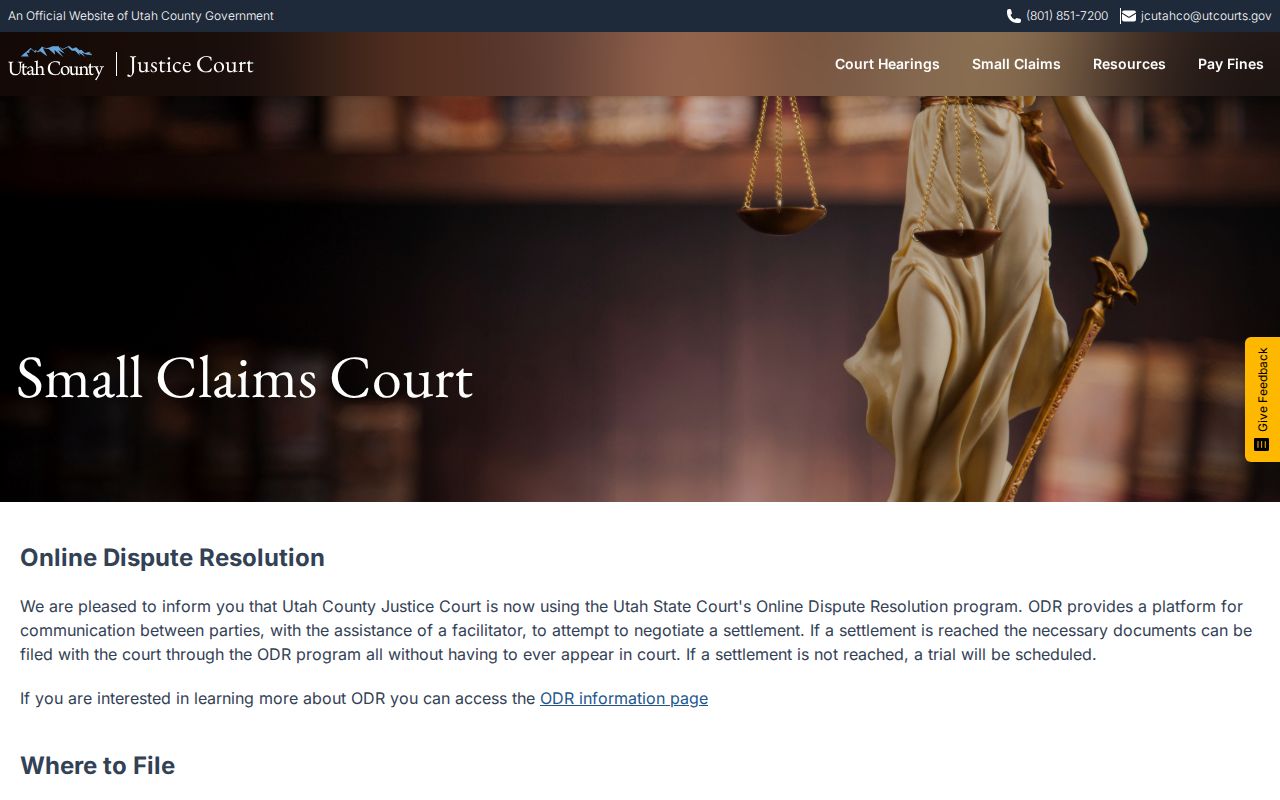
Qualifying parties may use Online Dispute Resolution to seek a settlement without an appearance, but the current court notice controls eligibility and deadlines.
Civil Case Types on the Docket
Fourth District Court civil coverage extends beyond basic contract claims. The code family separates the kind of filing so a search can be narrowed, and the event list then shows how that one case moves. Some categories have special access limits even when the case shell is visible.
- Contracts, debt collection, and judgment-related records.
- Automobile, intentional, malpractice, premises, product, and defamation torts.
- Property rights, liens, mortgage foreclosure, tax, and water cases.
- Domestic relations, custody, support, paternity, and protective matters.
- Estates, guardianships, conservatorships, trusts, and name changes.
Debt Collection code DC is not the same as a judgment code. AJ, FJ, HL, SL, and TL can point to abstracts, foreign judgments, or lien records. They may be post-judgment or administrative clues rather than the docket where the merits were first decided.
Utah County Civil Docket Routes
A Justice Court small-claims docket and a Fourth District Court civil docket are separate paths. That remains true even when both can be found through Xchange. A small-claims appeal goes to District Court as a trial de novo, meaning a new trial rather than a simple review of the Justice Court record. The appeal can therefore create a new District Court history with its own events.
This court-level distinction also determines the clerk. The Fourth District Court clerical division keeps District Court civil case files in Provo or Spanish Fork as routed. The county or municipal Justice Court clerk keeps its small-claims file. Utah County Clerk/Recorder does not keep either state-court docket. A request sent to the wrong office can delay access even when the record itself is public.
Utah County Civil Docket Hearings
A civil event should be read with both its date and status. “Scheduled” does not mean held. The later history may show continued, vacated, reset, disposed, or judgment entered. A motion filing also does not prove that the judge ruled on it. Look for the later order, hearing minute, or judgment entry, then confirm a near-term setting with the official calendar or filing clerk.
Service and return entries can explain why a setting changed, while a scheduling order can create deadlines that are not hearing dates. Due dates show when a paper was expected, not that it was filed. Xchange is the case-history source, and the calendar is the current setting source. If they appear to conflict, contact the clerk at the court shown in the header instead of assuming the older event controls.
Private Pleadings, Public Civil Dockets
A public case shell does not guarantee public pleadings. Utah lists many domestic and family categories as private civil actions, including divorce, custody and support, paternity, grandparent visitation, and several interstate family matters. Guardianship, conservatorship, civil stalking, and cohabitant abuse records also call for close classification review. Public parts may still include case history, hearing minutes, and certain judgments, orders, decrees, or letters of appointment.
The safe approach is to read the public event title, avoid copying minor names or private addresses, and ask the clerk whether the specific document is public. A missing PDF does not show that the event never occurred. It may reflect a private attachment, protected identifiers, image coverage, or processing. Court staff can explain the request route but cannot release a sealed or private item without rule-based entitlement or an order.
Certify a Utah County Civil Judgment
A judgment event in Xchange is a useful clue, but a screen view is not a certified judgment. First verify the case number, court, party roles, judgment date, and any later post-judgment entries. Then ask the filing clerk for the exact public document. The request can seek inspection before copies, which helps identify the right order when several judgment or amended-judgment lines appear.
The researched court fee schedule lists certification at $4 per document plus $0.50 per page. Staff may also need to classify and redact the record before release. If Xchange sells the electronic image, the court states that it will not fax or email that same document. A certified Utah County civil docket record still comes from the clerk, and the requester should follow that court's current delivery and payment instructions.
Utah County Civil Docket Access Rules
Public Utah County civil docket access comes through paid Xchange, a free courthouse terminal, or a specific request to the filing clerk. The Request for Court Record form can seek inspection, copies, certified records, non-Xchange documents, or a review of access rights. Mail, email, drop-box, and payment directions vary by court, so follow the current instructions of the District or Justice Court that holds the file.
Key Rules:
UCJA Rule 4-202.02 classifies court records as public, private, protected, or sealed.
UCJA Rule 4-202.03 sets entitlement categories for access to nonpublic records.
UCJA Rule 4-202.06 generally provides ten business days for an ordinary response.
A request must describe the record with reasonable detail. Inspection avoids a copy fee, while copies, staff time, certification, delivery, or media can cost more. A certified copy is $4 per document plus $0.50 per page under the researched fee schedule. The clerk may need to locate, classify, redact, and arrange payment before release. Xchange will not replace a certified judgment, and the court generally will not email a document already sold through Xchange.